Transportation
Japan transportation for snowboarders.
Japan's infrastructure is a gift. Use it intelligently and it protects your riding days; use it carelessly and it eats them.
The system
How you'll actually move.
Airports
Tokyo Haneda (HND) is usually the most convenient for onward rail to Nagano-area resorts. Narita (NRT) works but adds time. For Hokkaido, New Chitose (CTS) is the hub; Asahikawa (AKJ) is closer to Furano. Kansai (KIX) makes sense if you finish in Kyoto or Osaka.
Shinkansen
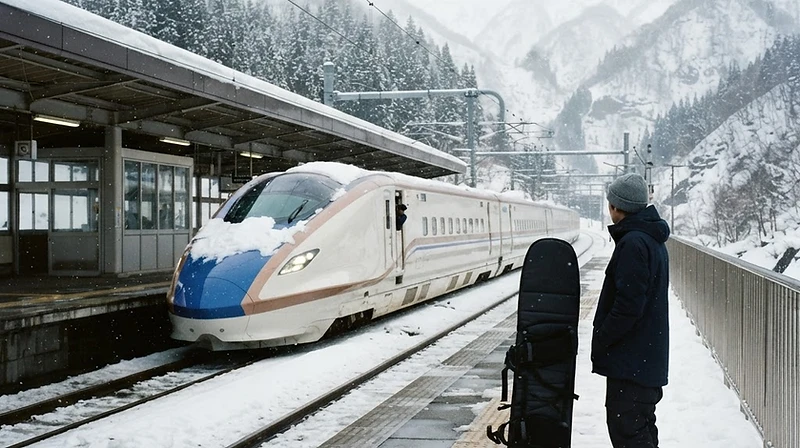
The backbone of Honshu snowboard trips. The Hokuriku line serves Nagano, Iiyama and Joetsu-Myoko; the Tohoku and Yamagata lines reach Appi and Zao. Oversized luggage on some lines requires a seat reservation with luggage space — check current rules before you travel with a board bag.
Local trains & buses
The last leg is usually a local train or express bus. Seasonal timetables change; verify before you go and avoid tight connections on arrival day.
Airport transfers
In Hokkaido, direct buses and private transfers from New Chitose to Niseko and Rusutsu are often the simplest option with board bags. Private transfers cost more but remove connections entirely.
Rental cars
Viable for experienced winter drivers, especially in Hokkaido. You'll need an International Driving Permit valid for Japan. Heavy snowfall, narrow roads and parking at resorts are real considerations.
Taxis
Useful for short hops between stations and lodges. In small resort towns, book ahead in peak weeks.
IC cards
Rechargeable IC cards (such as Suica or PASMO) simplify local trains, buses and convenience stores. Availability of physical cards has varied — mobile versions are an alternative for compatible phones.
Rail passes
National rail pass pricing has changed in recent years. Price your actual trips first; regional passes or individual tickets are often better value for a snowboard itinerary.
Key corridors
City to mountain.
Approximate door-to-door times. Seasonal timetables change — always verify.
| Route | How | Approx. |
|---|---|---|
| Tokyo → Hakuba | Hokuriku Shinkansen to Nagano, express bus to Hakuba | ~3.5–5h door to door |
| Tokyo → Nozawa Onsen | Hokuriku Shinkansen to Iiyama, bus to Nozawa | ~3–4h door to door |
| Tokyo → Myoko | Hokuriku Shinkansen to Nagano/Joetsu-Myoko, local line | ~3.5–5h door to door |
| Tokyo → Shiga Kogen | Hokuriku Shinkansen to Nagano, bus via Yudanaka | ~3.5–4.5h door to door |
| Tokyo → Zao | Yamagata Shinkansen to Yamagata, bus | ~3.5–4.5h door to door |
| Tokyo → Appi | Tohoku Shinkansen to Morioka, shuttle | ~3.5–4.5h door to door |
| CTS → Niseko | Resort bus or private transfer | ~2–3h |
| CTS → Rusutsu | Resort bus or private transfer | ~1.5–2h |
| Tokyo → Kyoto | Tokaido Shinkansen | ~2.5h |
Luggage forwarding
A tool that can dramatically simplify certain itineraries.
Not mandatory. Not a throwaway tip either. Here's when it earns its place.

When it makes sense
- Your trip starts in a city before the mountain.
- You have multiple train changes with board bags.
- Your lodging involves steep, snowy walks.
- You're moving between two mountain destinations.
When it doesn't
- A direct airport transfer takes you door to door.
- You're arriving the same day you want your gear.
- You're staying in one place the whole trip.
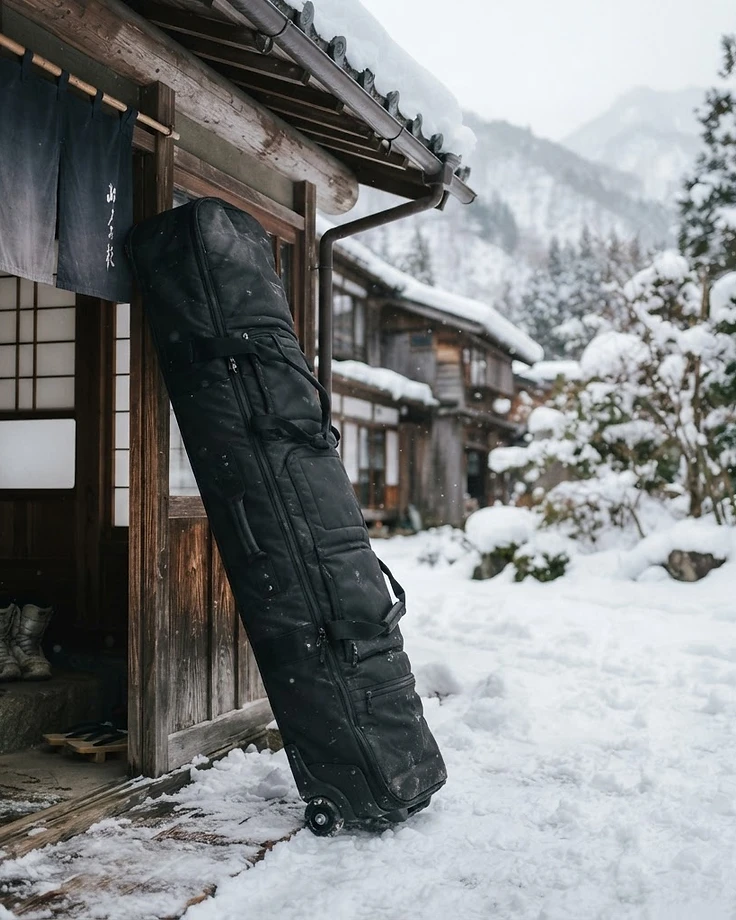
Dragging a board bag through the Tokyo subway system is the exact scenario forwarding exists to prevent. Turnstiles are tight, many staircases have no escalator, and a 165cm bag turns a quick cross-platform transfer into a shuffling, apologetic obstacle course through rush-hour crowds — you reach your train spent before you've even left the city. Set the bag down for a ticket or let go on a packed platform and there's a real chance of losing it: bags end up on the wrong train, grabbed by mistake, or simply gone in the crush.
- 01Drop offAt hotel front desks, airport counters or convenience stores. Services such as Yamato Transport (Kuroneko) are widely used.
- 02TimingDeliveries often arrive the next day or later depending on distance and season. Verify cutoff times and plan a day of buffer.
- 03Board bagsSnowboard bags are commonly accepted, sometimes with size limits. Confirm with the service.
- 04Carry with youBoots, goggles, one riding kit, medication, documents and electronics. If the bag is late, you can still ride.
 Yamato Transport (Kuroneko) is the most widely used service — check current rates, cutoff times and coverage on their site.
Flights
Flying in with a board bag.
Not a deals site. Just the decisions that change a snowboard trip.
Tokyo vs. Hokkaido arrival
For Hokkaido trips, many US riders connect through Tokyo to New Chitose. Compare total travel time, not just the international leg.
Open-jaw tickets
Arriving in Tokyo and departing Osaka (or vice versa) can remove a backtracking day if Kyoto is part of your trip.
Snowboard baggage
Airline policies on sports equipment vary and change. Check allowance, weight limits and fees for every carrier on your itinerary, including domestic legs.
Arrival timing
An afternoon or evening arrival usually means an overnight near the airport or in the city before transferring. Plan for it rather than fighting it.
Direct US → Japan routes
Awaiting verified, dated listAirline routes change seasonally. We only publish direct-flight information with a verification date — check airline sites for current schedules.